Law firms can make better financial decisions by organizing their data, connecting information across systems and using technology to create dashboards and automated reports for real-time insights. Reducing manual reporting processes and integrating information across systems boosts accuracy, visibility and decision speed. A structured approach accelerates profitability drivers, risk management and growth.
Law firms almost always have the information needed to make better financial decisions. But without structure, integration and intentional use, that data remains underutilized.
In a presentation to the Association of Legal Administrators Greater Los Angeles Chapter, Derek Barto outlined how law firms can move beyond fragmented reporting and begin using data as a true driver of financial strategy.
–>Access the “Utilizing Technology as a Financial Tool: Turning Your Information into a Strategic Asset” presentation [PDF] to gain deeper insights.
The CFO’s Role: Connecting Strategy and Operations Using Data
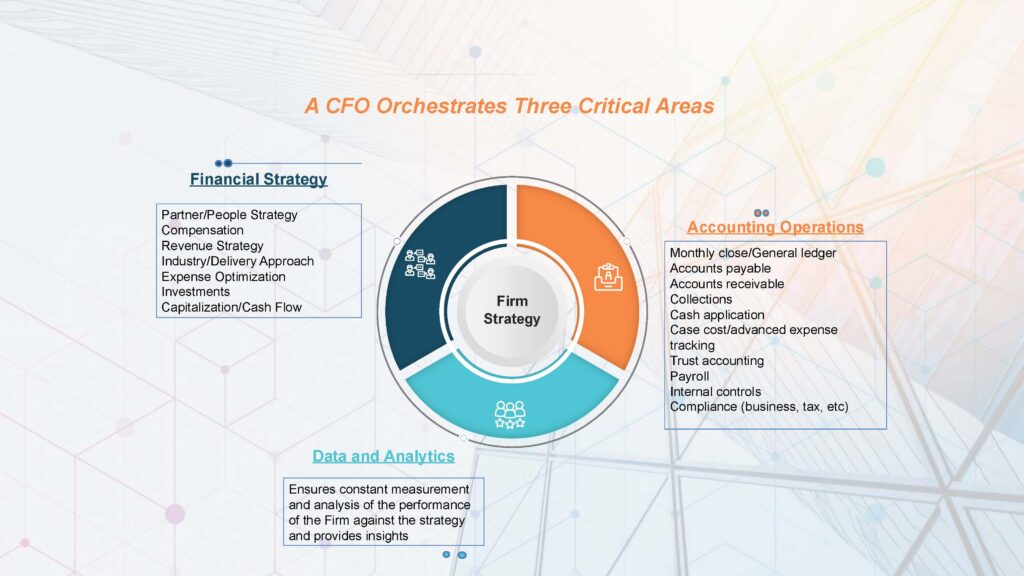
One of the foundational concepts Derek discussed is the financial leadership role in law firms. A chief financial officer (or fractional CFO) doesn’t just oversee accounting, they manage three critical components of a firm’s operations:
-
- Financial strategy (profitability, compensation, revenue planning)
-
- Accounting operations (billing, collections, payroll, compliance)
-
- Data and analytics (measurement, performance tracking, insights)
These areas must work in a continuous loop to support overall firm strategy. Without such integration, firms often operate reactively, making decisions based on incomplete or outdated information.
Law Firm Financial Data Is an Asset — But Only If It’s Usable
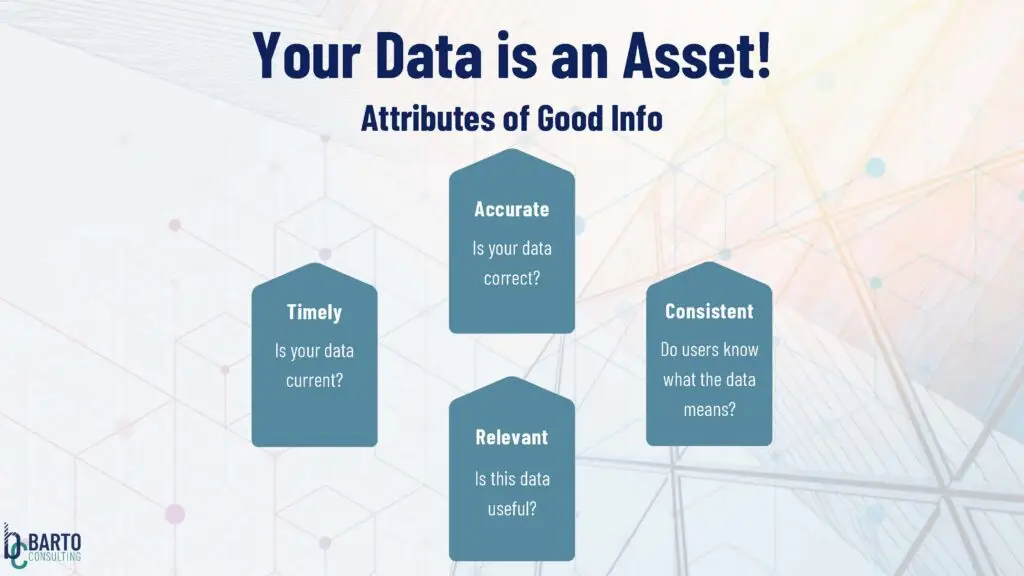
A key theme throughout the presentation is that data should be treated like any other valuable firm asset. But for data to be useful, it must meet these four core criteria:
-
- Timely – current and accessible
-
- Accurate – reliable and minimally dependent on manual manipulation
-
- Relevant – connected across systems to provide context
-
- Consistent – standardized so users can easily absorb and relate
Without these characteristics, the information supplied to firm management and lawyers may lack credibility or garner skepticism. For many law firms, this is where the breakdown occurs. Data exists, but it’s siloed, manually manipulated or inconsistent across reports. As a result, it is not used to its potential.
The Real Challenge: Data Lives Everywhere
Most firms store financial and operational data across multiple systems:
-
- Time and billing
-
- General ledger
-
- Payroll
-
- Departmental reports
-
- Standalone spreadsheets
This creates two problems: Leadership lacks a single source of truth and staff spend excessive time manually compiling reports. The result is delayed insights and missed opportunities.
Turning Data Into Insight: A Practical Framework
Derek discusses a three-step practical process for transforming raw data into actionable insights:
1. Clean/format to standardize how data is structured and organized.
2. Inter-relate to connect data across various systems and sources.
3. View/analyze the integrated data in one place to drive decision-making.
Technology: A Tool, Not the Solution
One of the more important (and often overlooked) points is that introducing new technology does not, by itself, solve problems. What maximizes the value of new technologies is when they are integrated with already functioning routines and processes.
Too often, law firms invest in new tools without first addressing the underlying processes and data structures — leading to expensive systems that still produce sub-par results and limited insight, or worse.
Successful technology adoption should increase access to information, reduce manual work and improve how workflows integrate between data systems. But first, law firms need to thoroughly review and scrutinize the processes they are wanting the tools to improve. Sometimes this alone can accomplish what firms are hoping new technology will achieve.
That’s where strategic financial leadership can make a measurable difference: helping law firms clean up processes and know what actions are required to then turn disconnected data into clear, actionable insights to advance the firm’s strategy.
If your law firm wants to turn financial data into clearer strategy for a stronger performance, contact Derek Barto, CPA — principal consultant of Barto Consulting LLP — to discuss how he can help your firm with finance and accounting strategy, reporting and systems improvements.